Anxiety Disorders in India: Understanding Prevalence and Culturally Sensitive Treatment Options
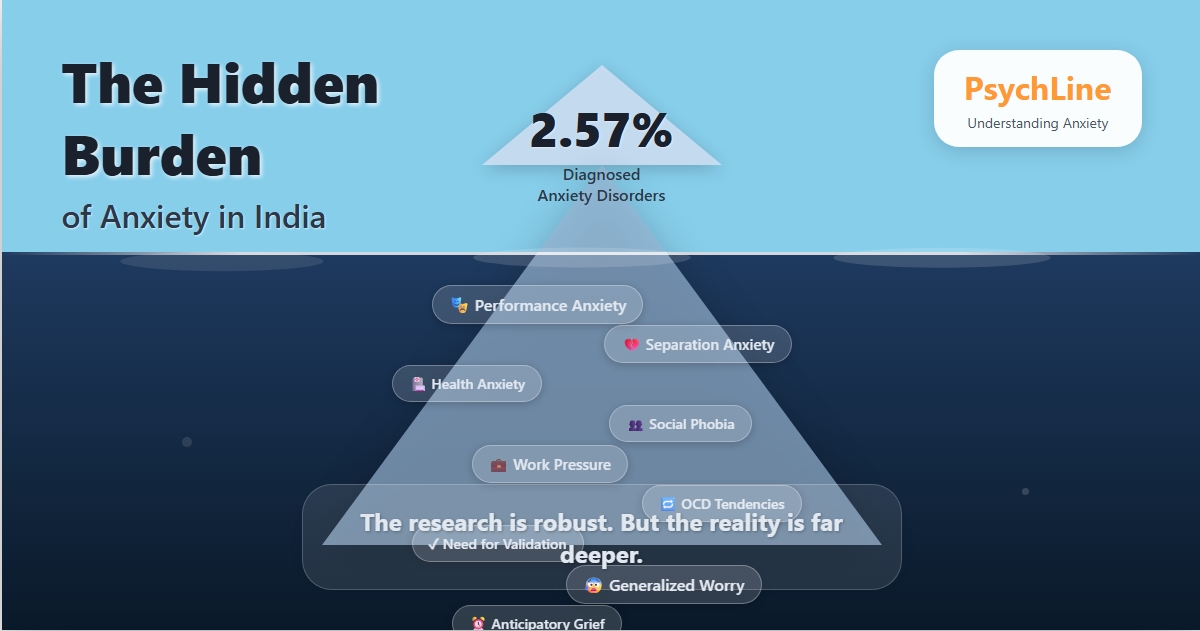
If you are reading this, there is a good chance you already know what anxiety feels like. The racing heart before a meeting. The spiral of worry at 2 a.m. about something you said three days ago. The knot in your stomach that shows up without warning and stays longer than it should.
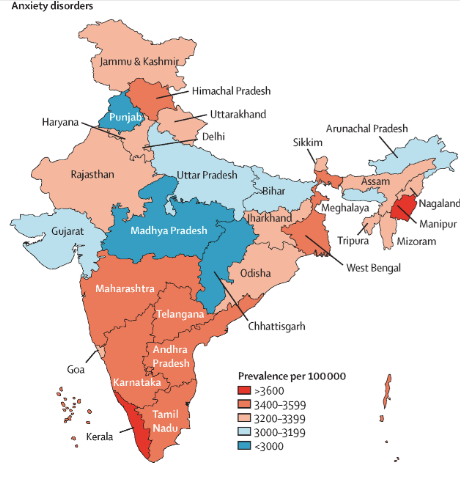
You are not alone. India’s National Mental Health Survey (NMHS) 2016, the largest mental health survey ever conducted in the country, found that anxiety disorders affect approximately 2.57% of the adult population. That may sound like a small number until you realise it translates to tens of millions of people. The Global Burden of Disease Study published in The Lancet Psychiatry estimated that in 2017, nearly 44.9 million Indians were living with anxiety disorders. Here s a state-wise distribution of the prevalence of Anxiety Disorders in India.
However, these surveys measured diagnosable anxiety disorders, conditions severe enough to meet clinical criteria in structured diagnostic interviews. But anxiety exists on a spectrum:
- The college student with crippling performance anxiety before exams
- The professional constantly seeking validation and reassurance from colleagues
- The parent with health anxiety who googles every symptom but functions “normally”
- The young adult with relationship-related separation anxiety that colors every interaction
- The person with subclinical OCD whose intrusive thoughts cause daily distress
- Those experiencing anticipatory grief as aging parents decline
- People with social phobias who’ve structured their entire lives around avoidance
These experiences are all manifestations of anxiety -real, distressing, and often debilitating. However, they may not reach the threshold of a formal disorder diagnosis, and honestly, don t even need a clinical label.
What makes the situation particularly difficult in India is the treatment gap. The same NMHS data showed that the treatment gap for anxiety disorders was 82.9%, meaning that more than eight out of every ten people with an anxiety disorder were receiving no treatment at all. In non-metro urban areas, this gap was even higher at 87.8%.
Why Anxiety Looks Different in India
Anxiety in India often does not look the way textbooks describe it. Research from NIMHANS and other Indian institutions has consistently noted that Indian patients frequently present with somatic symptoms, meaning physical complaints like headaches, stomach aches, chest tightness, and fatigue, rather than explicitly reporting worry or fear. This is partly a cultural pattern and partly because mental health vocabulary is still developing in many Indian communities.
The stigma surrounding mental health conditions also means that many people avoid seeking help. A situational analysis conducted in Haryana found that cultural beliefs, misconceptions about symptoms, and fear of being labelled as “paagal” (mad) were significant barriers to seeking care.
Does Online Therapy Actually Work for Anxiety?
The short answer is yes, and the research is strong. A large body of international evidence, including meta-analyses, has found that online cognitive behavioural therapy (CBT) has similar efficacy to in-person therapy for treating depression and anxiety disorders. Singh and Sagar (2022), writing in the Indian Journal of Psychological Medicine, noted that available literature supports the effectiveness of online CBT for anxiety and depression, though they also emphasised the need for more India-specific research.
A pilot study from India on a blended internet-based self-help and face-to-face intervention for depression (PUSH-D) conducted at NIMHANS found that blended interventions were effective in reducing depressive symptoms and could provide an opportunity for treatment intensification. This is encouraging because it shows that online and technology-based approaches are not just a compromise; they can genuinely help.
How PsychLine.in Can Help
At PsychLine.in, we understand that seeking therapy in India comes with its own set of barriers: stigma, affordability, accessibility, and the challenge of finding someone who truly understands the Indian cultural context. That is exactly why we exist. Our therapists are trained professionals who use evidence-based approaches while remaining sensitive to the cultural realities of Indian life. Sessions are conducted online, which means you can access quality care from anywhere in the country, whether you are in Mumbai, Indore, or a small town in Rajasthan. More importantly, if you want us to reach you for a free 15-minute intake session to understand your challenges and answer any questions about how this works, you only need to let us know and we ve got you!
➤ At PsychLine.in, we offer affordable, culturally sensitive online therapy with qualified professionals who understand the Indian context. Sessions are available in multiple languages. Reach out to us on WhatsApp at +91 9993954009 or visit www.psychline.in to book a session.
Reference
India State-Level Disease Burden Initiative Mental Health Collaborators (2020). The burden of mental disorders across the states of India. The Lancet Psychiatry, 7(2), 148 161.
Jayasankar, P., et al. (2022). Prevalence and its correlates of anxiety disorders from India s National Mental Health Survey 2016. Indian Journal of Psychiatry, 64(2), 138 142.
Sadh, K., et al. (2023). Mental health related stigma, service provision and utilization in Northern India. International Journal of Mental Health Systems, 17, 18.
Singh, S. & Sagar, R. (2022). Online Psychotherapy During the COVID-19 Pandemic: The Good, the Bad, and the Ugly. Indian Journal of Psychological Medicine, 44(1), 95 97.
Sudarshan, S., Mehrotra, S., & Thirthalli, J. (2024). Effectiveness of Blended Internet-based Self-help and Face-to-face Intervention for Depression: A Pilot Study from India. Indian Journal of Psychological Medicine, 47(2), 142 153.